01
Core judgment
Non-negotiable coherence, hierarchy, semantics, accessibility, and task fitness.
StyleSeed aims to make expert design judgment repeatable by coding agents, not replace experts with a fixed look. Today it selects the grammar the artifact needs, or compiles one from the user’s references. A separate brand recipe selects morphology rather than color. A palette recipe binds semantic color roles and generated-media anchors. Studio adds three directed concepts, a human decision, and executable interaction/media plans. Then ss-resolve hands the agent only the selected method and a source-hash manifest before the right renderer takes over. After a person accepts a correction, ss-learn can preserve a generalized local candidate without turning it into authority. The exact engineRevision makes later fixes detectable even when the semantic version has not changed. These mechanisms do not by themselves prove expert-level quality or universal compatibility with existing design systems.
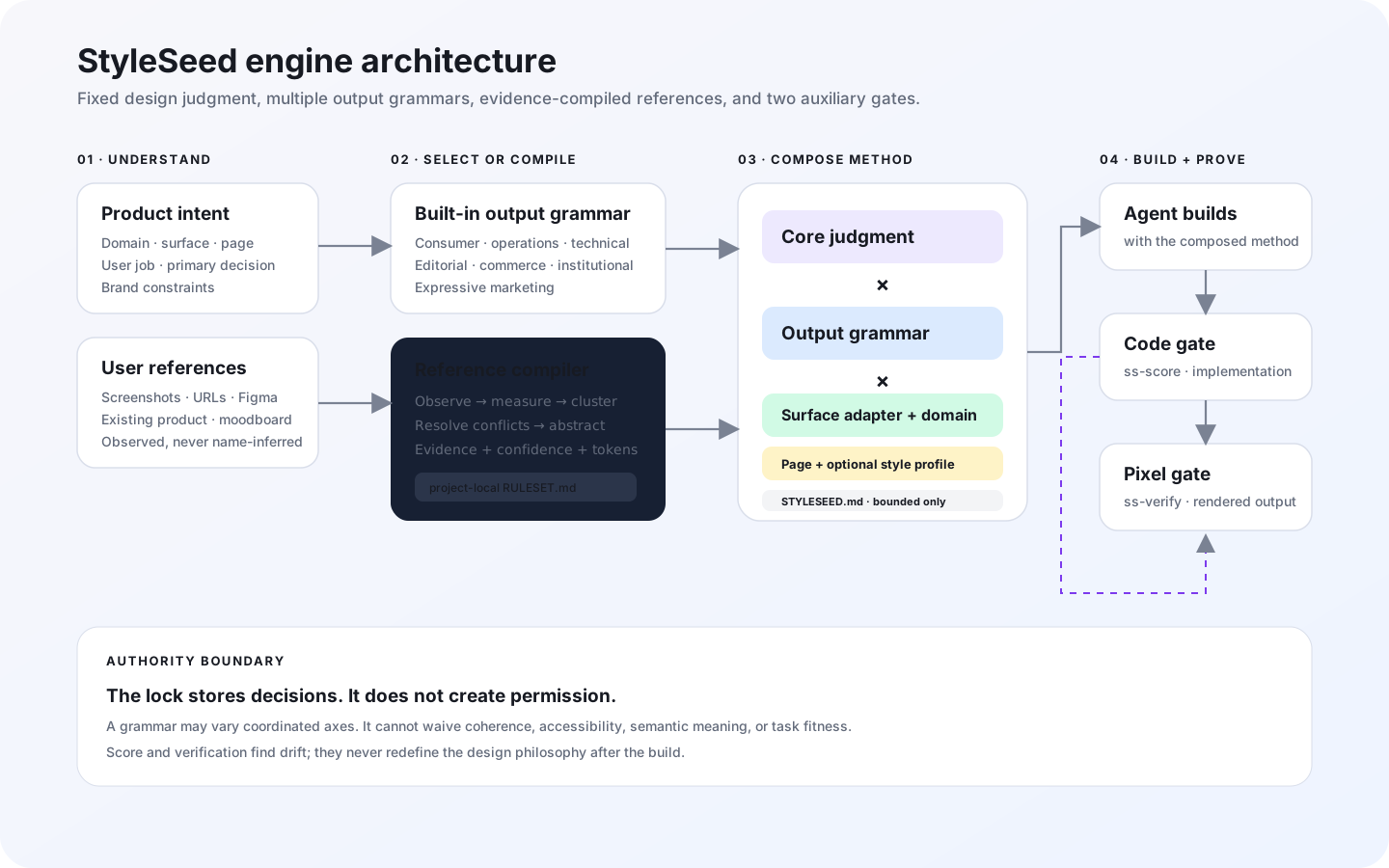
Non-negotiable coherence, hierarchy, semantics, accessibility, and task fitness.
Consumer service, operations, technical, editorial, commerce, institutional, marketing, or sequential story.
Web/mobile, carousel, slide deck, document/report, or single-frame renderer contract.
Nine reusable morphologies change containment, geometry, controls, collections, density, and motion without cloning a company.
Eight semantic systems bind canvas, chrome, action, status, focus, and generated-media anchors with deterministic contrast checks.
Turns screenshots, URLs, Figma exports, or an existing UI into a local grammar with evidence and confidence.
Produces native, signature, and experimental directions, records human selection, then compiles interaction scenes and image/video jobs.
ss-resolve emits only the selected 10–20KB method plus a manifest of selections, source hashes, and bundle hash.
The agent implements real content from the selected artifact bundle; legacy projects use effective-rules.md. It does not reassemble the full handbook.
Code and pixel checks find structural and rendered drift; temporal evidence proves the interaction, and acceptance is recorded only when that step actually ran.
ss-learn preserves an explicitly requested, caller-attested correction as a privacy-minimized candidate; it cannot scan a project or promote itself.
engineRevision hashes the maintained method, skills, plugin boundary, and palette engine so same-version fixes remain detectable.
The grammar owns attention and information order. The recipe owns geometry, containment, controls, and collection patterns. The palette owns role relationships and contrast. The skin implements project-specific colors and type tokens. This keeps a fashionable swatch from pretending to be a complete design system.
Compare all nine recipes/styleseed reference observes and measures the visible system, resolves contradictions, records evidence and confidence, compiles tokens and anti-patterns, then proves transfer on a screen or artifact absent from the source set.
ss-learn runs only on explicit request. It rejects project code, screenshots, prompts, identity, local paths, and brand secrets; records bounded applicability and counterexamples; and requires separate review and export attestations.
ss-update compares installed, project-recorded, and published revision hashes. Refresh happens through the original install channel, then the lock is re-resolved and checked. Project code, tokens, assets, and approved decisions stay owned by the project.